
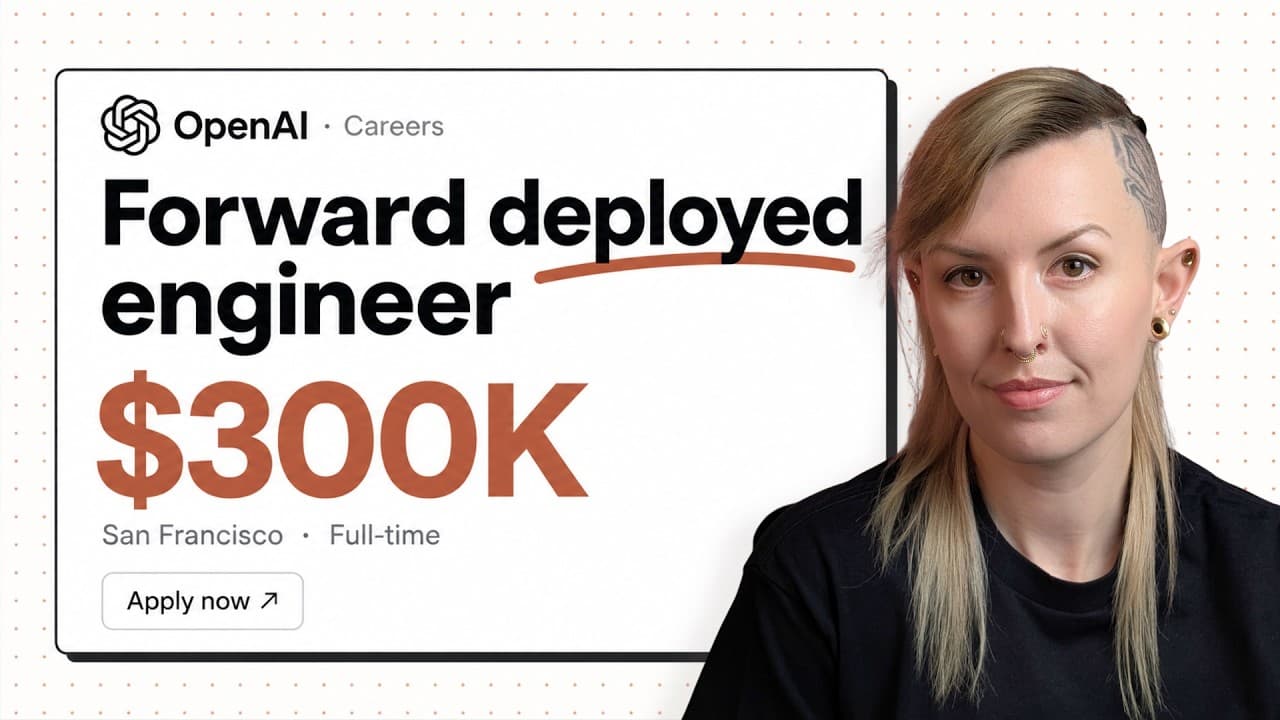
OpenAI is paying up to $300,000 a year for a role called Forward Deployed Engineer. Right now there are over 1,000 of these positions open at some of the biggest companies, and the field is growing year over year. I've worked with over 400 people on moving into AI roles, and for this guide I read 100 Forward Deployed Engineer postings to break down what the job is, who is a fit, and the exact plan I'd use to get hired.
The short answer: it's a mid-level role that wants three things at once: production software engineering, AI engineering (especially agents and evals), and real customer-facing skills. Most people get in through a lateral move, not by learning from scratch. So I'd build one end-to-end project that covers every layer, get customer experience at the job you already have, and then transfer internally, apply directly, or join a smaller company doing the same work under a different title.
The short version
| Topic | What the postings say | What to do |
|---|---|---|
| The job | Build production AI systems for one client, often from inside their office | Be ready for travel and lots of people time |
| Pay | Base typically $175K–$195K, frontier labs higher, plus stock and bonuses | Look at total comp, not just base |
| Experience | Median 5 years; ~12% entry-level; 68 of 100 never mention a degree | Focus on proof of work, not credentials |
| Software skills | Production systems (87%), APIs (~70%), system design (~70%), Python (63%), TypeScript (~50%) | Skip Kubernetes, Terraform and CI/CD until you need them |
| AI skills | LLMs (67%), agents (57%), evals (53%), RAG and prompting (~28%) | Spend extra time on evals. Skip fine-tuning and GPU optimization |
| Customer skills | Customer-facing (71%), communication (68%), discovery and scoping (68%), stakeholder management (56%) | Run one internal project as a full customer loop |
| Getting in | Lateral transfers are the most common path | Transfer internally, apply directly, or look past the job title |
| Interviews | Scoping problem, unfamiliar code, practical coding, a build you defend, past-project deep dive | Ask about the user and the goal before suggesting anything |
If you want the whole list of skills and how often each one showed up, I made a free FDE skills checklist.
What is a Forward Deployed Engineer?
The Forward Deployed Engineer title comes from Palantir, where it's been around for over a decade. But in the last year or so, a lot of the big AI companies have started hiring for it too.
The basic situation is that a company buys an AI product, or wants to build something on top of a model, and the hard part for them is making it work within their systems and team. So the vendor, like OpenAI, sends an engineer to work directly with that customer, figure out what they need, and then actually build it out for them.
It's essentially an AI engineering job where you're building production systems. But instead of building them internally for one company and many clients, you're building them externally for one client, often physically from within the client's office. That comes with a lot of complexity, travel, and the additional layer of people skills on top of technical skills.
Which is why the pay is what it is. Base salaries typically start between $175,000 and $195,000, the frontier labs of course pay higher, and base is usually a fraction of total compensation once you add in stock and bonuses.
It's also why these companies are picky about who they hire. The job of an FDE is half building production AI systems and half dealing with customers, and most people, in my experience, are only good at one of those things.
Who actually gets hired as a Forward Deployed Engineer?
If you read the postings literally, they want someone who's a senior engineer, an experienced consultant, and a product manager all at the same time. Clearly that's not realistic. So instead I looked at two things: what the 100 job postings list as requirements, and where the people who currently have this title came from.
What the postings require
On requirements, it's a mid-level role for the most part:
- The median experience required on the postings was 5 years.
- About a third of postings would take 3 years or less.
- Only around 12% of FDE roles are truly entry-level.
So experience is pretty important, and actually more important than credentials seem to be. 68 of the 100 postings never mention a degree at all. For these roles, they care a lot more about proof that you can do the job than anything formal.
Where current FDEs came from
Close to half of current FDEs were software engineers. About a fifth were solutions engineers or architects, and the rest came from data roles, technical consulting, and, actually, founders.
So for most people this is a lateral move that builds on top of your existing skills, not something you'd learn from scratch. That makes sense, since it's only really been a thing for the last couple of years.
At a high level, the skills fall into three buckets:
- Software engineering and building production systems
- AI engineering
- Effectively interacting with customers and stakeholders
Depending on where you're starting from, you might already have some of these in your background. Let's take a deeper look at each one.
The software engineering skills FDE postings ask for
Production experience
The first thing almost every posting asks for is experience building production systems. This was listed in 87 of the 100 postings.
The catch is that "production experience" means different things to different people, and a lot of folks aren't sure whether their past experience counts. If you've built internal tools, or notebooks, or a side project a few friends used, is that production?
Reading through the posting descriptions, I think the consensus is that your work counts as "in production" if there were users who could break things and you'd have to fix it. So a notebook you run manually for yourself doesn't count, but an internal tool definitely would.
System design and APIs
The second thing the postings really focus on is comfort with system design and building with APIs. About 70% ask for experience building APIs and integrations, and another 70% ask for system design.
It's extra tricky for an FDE because they don't design systems from a completely clean starting point. They have to build something that works within the customer's existing architecture. So it's less about having textbook knowledge of the perfect system, and more about just making something work.
This is one of the reasons the data layer comes up in a bunch of postings:
| Skill | Share of postings |
|---|---|
| Databases and data modeling | ~31% |
| Data pipelines | 27% |
| SQL | 15% |
Again, they're looking for someone with design sense within an existing system.
Languages
You might assume Python, and that's half right. Python is listed in 63 of the 100 postings, but TypeScript or JavaScript shows up in about half, and nearly 40% want full-stack or frontend work.
Cloud and security
The final thing to be comfortable with in the production software realm is cloud and security. About 38% of postings ask for experience with AWS, GCP, or Azure, and 43% mention security, auth, or compliance.
What to skip
Other skills came up in the postings, but only occasionally. So if you're starting from scratch, I'd skip Kubernetes, Terraform, and CI/CD until you need them.
The AI engineering skills FDE postings ask for (and the one most people skip)
That covers the software side. The AI skills are where the postings get a lot more specific.
Unsurprisingly, the core of the AI work for FDEs is building with LLMs. 67 of the 100 postings ask for experience with this.
Agents
57% of postings ask for experience with agents or agentic systems, which puts it above everything else on the AI list. To be clear, they don't mean using an agent to code, like Claude Code. That's just kind of assumed. They mean building systems where the model is deciding what to do next, can call tools, and runs through a multi-step workflow rather than answering a single prompt.
That being said, the postings mostly don't care which framework you use. LangChain, LangGraph and friends are in 19% of the postings, and almost half of those are just nice-to-haves.
Evals
The second most requested skill is evals, and this is the one I'd pay the most attention to. It shows up in 53% of postings, and it's named specifically at places like Anthropic, Snowflake, Databricks, and OpenAI.
Remember, an FDE has to convince a customer that what they're building actually accomplishes the customer's goals, and you need really strong evidence of that. Most people building AI apps right now skip this entirely, which is why it's such a strong differentiator.
RAG, prompt engineering, and AI safety
It's also important to be familiar with RAG and strong with prompt engineering as a discipline. Both show up in about 28% of postings.
AI safety shows up in about 21%, and this is growing fast because the customers are more often in regulated environments like banks and healthcare.
What to skip
| Skill | Share of postings |
|---|---|
| Classical ML | 18% |
| Fine-tuning | 11% |
| Inference or GPU optimization | 5% |
These will be helpful if you're already coming from machine learning, but they're huge fields, and it's probably not strategic to try learning them from scratch.
The customer skills that don't come naturally to engineers
So far everything on the list is what you'd expect from an AI engineering job. But there was a whole group of requirements that showed up about as often as the engineering did, and many of them do not come naturally to engineers.
- Customer-facing experience came up in 71% of postings. This could be from consulting, solutions engineering, or even just being a really engaged engineering partner to a non-technical team. I bet they'd take sales or support if that's in your background, too.
- Communicating with both technical and non-technical people is in 68% of postings and almost always required.
- Discovery and scoping is also in 68%. This sounds a lot like scoping any big engineering project with cross-functional stakeholders, except that you also have to understand and respect their existing systems and politics.
- Stakeholder management is in 56%, and executive presence in about half. Once you have a plan in place, you have to carry it out yourself and keep the customer happy along the way, and you'd often be reporting to decision-makers.
You might see from this list that it takes a certain kind of person to enjoy this work. A lot of what will make someone succeed, or not, is personality. Comfort with ambiguity and high agency are in 65% of postings, and end-to-end ownership is in 72%.
And you need to at least enjoy thinking about the business side of things. Business acumen and product sense each show up in about 54% of postings, but almost never as a requirement, usually as a nice-to-have. They're in the job description to describe how you'd be tying your work to a business outcome for the customer, and bringing what you learned back to the product team. Understanding how your engineering contributions impact a company is a big part of what you'd be thinking about.
How I'd make myself qualified for an FDE role
I know this list is pretty long, but I don't think you need to learn these one at a time. Remember, the postings are mostly looking for proof that you've done this kind of work before. So I'd focus on building one super dope project that covers all of the layers, and then on getting some customer experience at the job you already have.
Build one project that covers every layer
- Start with a normal production app. Something with an API, a database, and auth, deployed somewhere on the cloud with logging and all that jazz. If you're already a software engineer, this part will probably be quick, but you still have to build it, because the AI layers that come next need a baseline to build on.
- Add an LLM feature to that same app.
- Make it agentic, so the model is calling tools and working through multi-step tasks.
- Put evals around the whole thing, so you can confidently show that it works. Evals are the most important part that people skip, so it's worth spending a good amount of time there.
Learn deeply about each component as you go.
Get customer experience without a new job
For the customer side, you don't really need a new job if you're creative here. Most companies have some team with a problem you could solve. If you:
- have a discovery conversation with them,
- write up a short scoping doc,
- build it out, and
- demo it back to them,
that's basically the whole customer loop an FDE does, from one internal project. It also gives you a concrete outcome you can talk about later.
I'd argue it's even worth taking some of your own time to build something outside of your core responsibilities if needed. It's not just you doing free work for the company if it specifically moves you toward your goals.
Paths into a Forward Deployed Engineer role
Once you've developed the skills and demonstrated them with an end-to-end project, you have a couple of options.
Apply directly
The most obvious option is applying directly to Forward Deployed Engineer postings. If you've got five or so years of production experience plus a strong project and a network, that's a perfectly reasonable thing to do. But when I looked at how people who have the title today actually got there, many of them didn't do that.
Transfer internally
The most common path is a lateral transfer. Many current FDEs were already at a company that had FDE or FDE-type work, usually as a solutions architect or solutions engineer, and moved over internally. OpenAI's head of FDE came up that way, and so did a bunch of folks I found at Salesforce.
If you're at a company that's starting an FDE team, which right now includes Databricks, Salesforce, Google Cloud, AWS, and a long list of AI companies, lucky you. This might be as simple as getting the right people to vouch for you.
Join a smaller company (and look past the title)
Another path is joining a smaller company that's doing this kind of work, maybe under a different name. 58% of FDE roles are at companies with somewhere between 11 and 200 employees, and plenty of them call it a different title even if it's the same responsibilities. I saw one company that lists these roles as "Software Engineer, Agent," so it's worth focusing more on what the posting says than the exact title.
Play the longer game
Or you could get a role that builds the background these companies are looking for, like consulting, systems integration, or even founding a startup. One company report I found said roughly one in six of their hires is a former founder, so weirdly, that might be an option.
Early-career programs
If you're early in your career, there are a couple of programs to know about:
- Palantir has a new grad FDE track, and separately a "Build to Apply" route where you submit a recorded demo of something you built on their platform instead of going through the normal resume screen.
- Sierra has a new grad track.
- LangChain has an early-career deployed engineer role.
What Forward Deployed Engineer interviews look like
Once you're actually in the process, the interviews look a bit different from a normal software engineering loop. Luckily, the pattern across companies is pretty consistent:
- An open-ended scoping or decomposition problem. You get a vague business goal and have to turn it into a system. What they're watching for is whether you ask about the user and the goal before you start giving suggestions.
- A round where you work in code you didn't write, which makes sense, because that's what you'd be doing on the job.
- A practical coding round rather than LeetCode, thankfully.
- Often a take-home or a live build that you then defend as if you were presenting it to a customer.
- A deep dive on a past project, mostly about whether you really owned it.
Is becoming a Forward Deployed Engineer worth it?
That depends a lot on what kind of person you are, because the things some folks would consider downsides are exactly what other people will love about this job.
- You'd be traveling a good amount. 45 of the 100 postings mention travel, and it's usually listed at about 25 to 50% of your time. Plus, most of the frontier lab roles are hybrid, with a few days a week in the office.
- You'd be talking to people constantly, and a lot of them would be non-technical customers who are stressed about a project they're paying a lot of money for.
- Some weeks would look more like consulting than engineering, with scoping docs, status updates, and keeping stakeholders calm.
- It's not an easy role to get into.
But if you read all that and thought, "actually, that sounds kind of fun," then this is probably a great fit for you. The pay is some of the best in the industry right now, the field is growing fast, and you'd get to see how AI gets used inside a ton of different companies across a bunch of different industries. That experience is really hard to get any other way. Plus, the problems change with every customer, so it's pretty much never boring.
If you like building things, you like people, and you don't mind a bit of chaos, this is one of the best jobs in AI right now. And the path to get there is actually pretty doable if you approach it correctly.
What to learn next
If you want an overview of AI engineering as a whole, I have a 76-minute breakdown covering the field in detail.
And if you want help building your own production-ready project, I run a small, application-only build cohort where I personally work with a handful of people over eight weeks to take an AI Engineering project all the way through deployment.
Frequently asked questions
What is a Forward Deployed Engineer?
A Forward Deployed Engineer (FDE) is an engineer a vendor, like OpenAI, sends to work directly with a customer: figuring out what they need and building it inside their systems. It's essentially an AI engineering job building production systems, but externally for one client, often from inside the client's office. The title comes from Palantir, and many big AI companies have started hiring for it in the last year or so.
How much do Forward Deployed Engineers make?
Base salaries typically start between $175,000 and $195,000, and the frontier labs pay higher. OpenAI pays up to $300,000 a year for the role. Base is usually only a fraction of total compensation once stock and bonuses are added.
Do you need a degree to become a Forward Deployed Engineer?
Usually not. 68 of 100 FDE postings never mention a degree at all. Experience matters more: the median posting asks for five years, about a third would take three or less, and only around 12% of FDE roles are truly entry-level.
What skills does a Forward Deployed Engineer need?
Three buckets: software engineering (production systems, APIs and integrations, system design, Python and TypeScript, cloud and security), AI engineering (building with LLMs, agents, evals, RAG and prompt engineering), and customer skills (customer-facing experience, communicating with non-technical people, discovery and scoping, and stakeholder management). Evals are the AI skill most worth extra attention, because most people building AI apps skip them.
What can I skip when preparing for a Forward Deployed Engineer role?
If you're starting from scratch, skip Kubernetes, Terraform and CI/CD until you need them. On the AI side, classical ML shows up in 18% of postings, fine-tuning in 11% and inference or GPU optimization in just 5%. They help if you already come from machine learning, but they're huge fields and not strategic to learn from scratch for this role.
How do people actually become Forward Deployed Engineers?
The most common path is a lateral transfer: many current FDEs were solutions architects or solutions engineers at a company that started FDE-type work and moved over internally. Other paths are applying directly with about five years of production experience, joining a smaller company doing the same work under another title, or building relevant background in consulting, systems integration or founding a startup. Palantir, Sierra and LangChain also have early-career tracks.
What are Forward Deployed Engineer interviews like?
They differ from a normal software engineering loop. Expect an open-ended scoping or decomposition problem, a round working in code you didn't write, a practical coding round rather than LeetCode, often a take-home or live build you defend as if presenting to a customer, and a deep dive on a past project to check whether you really owned it.